
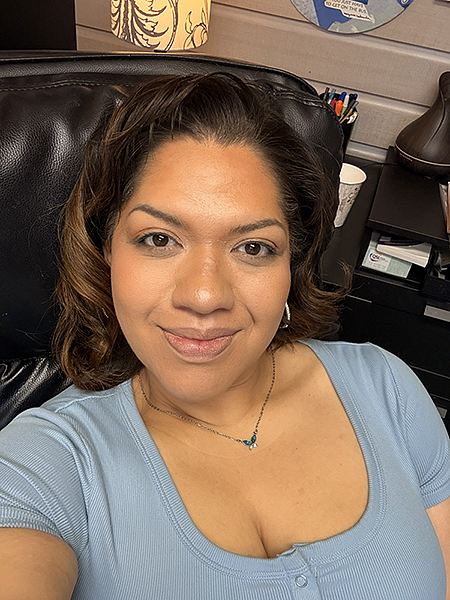
FHS Alumni Sarai Santos Finding Purpose Through Education
Meet Sarai Santos, MS, QMHP, LMFT, who received her bachelors in Family and Human Services in 2014, and her master's in Couples and Family Therapy in 2017 and learn about her journey from first-generation student to bilingual mental health therapist.
"Be courageous and speak out, don’t be afraid to advocate for yourself or take up space where you have something to contribute because your voice and your experience are valuable, valid, and important to have in higher education." –Sarai Santos
Sarai’s educational journey exemplifies how higher education can serve as a catalyst for personal transformation, professional purpose, and community impact. As a first-generation college graduate, Sarai’s experience reflects resilience, self-advocacy, and a deep commitment to culturally responsive mental health care. Today, her work as a bilingual mental health therapist and community leader demonstrates the enduring value of an education grounded in equity, critical reflection, and human connection.
Sarai currently works at the Looking Glass Counseling Program as a Bilingual Mental Health Therapist, where her role extends far beyond traditional clinical work. In addition to providing therapy services, she serves as the program’s BIPOC Outreach Coordinator, participates in the Early Childhood team, and facilitates a 10-week Liberation Series focused on decolonizing mental health. Her multifaceted responsibilities underscore a professional identity rooted in both clinical excellence and systemic change. For Sarai, education was not simply a means to a career, but a foundation for meaningful, values-driven work.
When Sarai first entered the University of Oregon, her academic goals looked quite different. She initially planned to graduate from the FHS program and pursue nursing. However, her trajectory shifted after enrolling in a counseling skills course within the program. “Having taken the counseling skills course cemented my decision to pursue a career in the counseling field as a therapist,” she shared. That single course proved transformative, revealing the profound impact that therapeutic skills can have on individuals and communities. This experience highlights the importance of exploratory learning within higher education and the role of the COE in exposing students to diverse pathways in helping professions.
Sarai’s pride in her current work stems from the relational nature of counseling and the mutual growth it fosters. While acknowledging the challenges inherent in the field, she finds affirmation in moments of connection and self-discovery. “Being able to connect with others in a way in which they, and to a certain extent myself, are able to learn about themselves…has affirmed the work I have chosen to do,” she reflected. This perspective reflects the COE’s emphasis on reflective practice and human-centered education, principles that continue to shape her professional identity.
During her time in the COE, Sarai was influenced by mentors and peers who modeled advocacy, representation, and accountability. In the Couples and Family Therapy program, a PhD student supervisor played a particularly meaningful role. As a woman also of color navigating higher education, this supervisor not only provided guidance but also representation. Sarai recalled feeling inspired and supported, especially when she decided to speak up about inequities she was experiencing. That advocacy was further reinforced by faculty member Tiffany Brown, PhD, who “took action to resolve the issues and included me in the process.” These experiences illustrate how supportive mentorship within the COE can empower students to challenge inequities while remaining engaged in their academic communities.
Equally impactful were Sarai’s peers in the Spanish Language Psychological Service and Research Specialization program, where collaboration with master’s and aspiring PhD students created a space to develop culturally and linguistically responsive skills. Working alongside others who shared similar goals allowed her to focus on the “unique skills and considerations when working with the Spanish-speaking community.” This collective learning environment reflects the COE’s commitment to preparing educators and clinicians to serve diverse populations with competence and care.
As a first-generation college student, Sarai entered higher education with a strong sense of its importance, instilled by her parents. Her experience at the COE deepened that understanding by teaching her how to navigate institutional systems and expectations. She noted that participation in higher education also helped her contextualize the struggles she faced as a first-generation student and student of color. Through this process, she gained “skills, knowledge, and resilience to navigate systemic structures.” For Sarai, the value of higher education lies not only in professional preparation, but in the development of critical awareness and self-advocacy.
Support systems played a crucial role in helping Sarai balance school and personal life. She credits her family, the Student Support Services program, and the Center for Multicultural Academic Excellence (CMAE) as having the greatest impact on her success. These formal and informal networks provided both resources and a sense of belonging—an essential component of persistence in higher education.
Sarai found peace in the everyday spaces at UO that supported her learning. Quiet areas to study, read, and write, often near a coffee bar, offered moments of calm amid academic demands. The College of Education computer lab became a particularly valued resource, offering practical support such as chargers, workspace, and last-minute printing. These seemingly small resources played a meaningful role in her ability to succeed.
Looking back, Sarai would encourage her younger self to be courageous and speak out. “Don’t be afraid to advocate for yourself or take up space…because your voice and your experience are valuable, valid, and important,” she advised. This message reflects the growth she experienced through higher education and the confidence she gained by engaging fully in academic and professional spaces.
Sarai’s aspirations for the future center on continued service to the Spanish-speaking community, people of color, and individuals who have experienced trauma. She hopes to become a bilingual and bicultural clinical supervisor, supporting emerging clinicians and fostering critical conversations about history, identity, and power within therapeutic relationships. Ultimately, she aims for her work to increase access to mental health services and promote meaningful, community-centered change.
Sarai Santos’s journey illustrates how an education from the University of Oregon College of Education can shape not only a career, but a lifelong commitment to advocacy, healing, and equity. Her story stands as a testament to the transformative power of higher education, and to the impact that one empowered graduate can have on their community and field.