
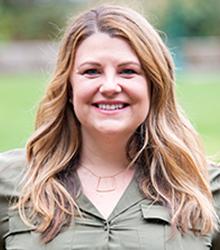
Tiffany Brown
Biography
Dr. Tiffany Brown (she/her) is a licensed marriage and family therapist and serves as a Teaching Professor, Program Director, and Clinical Director in the Couples and Family Therapy graduate program. She is also the Director of the Center for Healthy Relationships in the HEDCO Clinic. Her clinical and research work centers on substance use and recovery, collegiate recovery programs, and self-harm. More recently, she has integrated these areas to study the intersection of mental health, athletic systems, and athletes from high school teams to Olympians. As a first-generation college student, she brings a personal understanding of the challenges of navigating higher education.
Dr. Brown’s current research explores the mental health needs of athletes in women’s sports through qualitative methods and her book, The Price She Pays: Confronting the Hidden Mental Health Crisis in Women’s Sports—from the Schoolyard to the Stadium (Little, Brown Spark, an imprint of Hachette Book Group). She has also examined the effectiveness of collegiate recovery programs in supporting students. She completed specialized training in substance use and recovery at the Center for the Study of Addiction and Recovery at Texas Tech University.
She is committed to advocacy for individuals in recovery and to challenging the stigma surrounding substance use, including critically examining the racist, sexist, and ineffective history of the “war on drugs.” Dr. Brown has collaborated with Substance Abuse and Mental Health Services Administration (SAMHSA) to support the development and sustainability of collegiate recovery programs through the Bringing Recovery Supports to Scale Technical Assistance Center Strategy (BRSS TACS).
Her clinical experience includes self-harm education, prevention, and intervention, as well as work with families navigating substance use and recovery. During an intensive internship at a pediatric hospital, she gained experience in grief and loss, pediatric oncology, and pediatric intensive care. She was trained in Medical Family Therapy within interdisciplinary medical teams and regularly consults with schools and community organizations on best practices for screening and intervention related to self-harm. She is a Clinical Fellow and Approved Supervisor with the American Association for Marriage and Family Therapy (AAMFT) and an approved supervisor in the state of Oregon.
Following the 2015 mass shooting in her hometown of Roseburg, Oregon, Dr. Brown joined a statewide multidisciplinary taskforce to provide crisis support for survivors and the broader community. She worked on-site for several months, supporting students, faculty, and staff as they navigated the immediate and ongoing impacts of violence and trauma. This experience informs her continued consultation with clinicians working with survivors of mass violence.
Dr. Brown is active in her local community and has served on many nonprofit boards, including Courageous Kids, the Association of Recovery in Higher Education (ARHE), Carry It Forward, and Ophelia’s Place.
Commitment to Anti-Racism and Social Justice
I approach anti-racism not as a discrete set of actions, but as an ongoing practice embedded across my teaching, research, clinical work, and leadership. I strive to cultivate learning environments that are equitable, justice-oriented, and responsive to the lived experiences of students and colleagues.
As a white, cisgender, able-bodied professional with unearned privilege, I am committed to using my positional power to elevate others and decenter myself. My work is grounded in a rejection of performative justice and instead emphasizes sustained, intentional action. This includes attending to the intersectional identities of those I work with, challenging systems of inequity, and creating space for collective change.
I actively work to decenter whiteness and interrogate dominant norms within academic and clinical spaces, while recognizing that these efforts alone are not enough. I remain committed to supporting the visibility, leadership, and scholarship of faculty and students of color, Indigenous scholars, and other historically marginalized communities.
Across my work, I continually ask: Who is included? Who is missing? Whose knowledge is centered? And who has access to the resources and opportunities these systems provide?
Education
Honors and Awards
2019 Excellence in Supervision Award, College of Education, University of Oregon
2014 Early Career Teaching Award, College of Education, University of Oregon
2002 University of Oregon Peer Advisor of the Year
2001 - 2002 Alpha Kappa Delta Honor Society
Publications
Steele, K., Brown, T., & Strout, E. (2024). The price she pays: Confronting the hidden mental health crisis in women’s sports – form the schoolyard to the stadium. Little, Brown Spark, Hachette Book Group.
Nichols, L.M., Brown, T.B., Allmendinger, A., Hennessy E.A., & Tanner-Smith, E.E. (2025). Substance use recovery needs among college students seeking recovery services: A thematic qualitative analysis. Addiction Science & Clinical Practice, 20(1), 2. https://doi.org/10.1186/s13722-024-00518-x.
Hennessy E.A., Nichols, L.M., Brown, T.B., & Tanner-Smith, E.E. (2022). Advancing the science of evaluating Collegiate Recovery Program processes and outcomes: A recovery capital perspective. Evaluation and Program Planning, 91. doi.org/10.1016/j.evalprogplan.2022.102057
Hennessy E.A., Tanner-Smith, E.E., Nichols, L.M., Brown, T.B., & Mcculloch, B.J. (2021). A multi- site study of emerging adults in collegiate recovery programs at public institutions. Journal of Social Science & Medicine, 278. doi: 10.1016/j.socscimed.2021.113955
Nichols, L.M., Hennessy, E.A., Brown, T.B., & Tanner-Smith, E.E. (2021). Co-occurring mental and behavioral health concerns among collegiate recovery program members. Journal of American College Health, 1-8. doi: 10.1080/07448481.2021.1955687
Todahl, J., Brown, T.B., Barkhurst, P., Maxey, V., & Simone, A. (2019). Public opinion and child abuse prevention planning: A qualitative investigation. Journal of Interpersonal Violence, 36(7). doi: 10.1177/0886260519845714
Ashford, R., Brown, A., Brown, T.B., Callis, J., Cleveland, H.H., Eisenhart, E., Groover, H., Hayes, N., Johnston, T., Kimball, T., Manteuffel, B., McDaniel, J., Montgomery, L., Phillips, S., Polacek, M., Statman, M., & Whitney, J. (2019). Defining and operationalizing the phenomena of recovery: A working definition from the recovery science research collaborative. Addiction Research and Theory, 27(3). doi: 10.1080/16066359.2018.1515352
McDaniel, J., Brown, A., Heller, A., Johnston, T., Bergman, B., Bohler, R., Brown, T.B., Eisenhart, E., Finch, A., Harper, K., Hart., C., Kimball, T., Rabolt, T., Speciale., C., Whitney, J., & Ashford, R. (2019) Interdisciplinary expansions: Applying recovery-informed theory to interdisciplinary areas of recovery Science Research. Alcoholism Treatment Quarterly, 38(4). doi: 10.1080/07347324.2019.1701598
Brown, T.B. & Sidlauskas, R. (2016) Application: Self-Harm. In R.W. Summers (Ed.), Social psychology: How other people influence our thoughts and actions (pp. 143-159). Santa Barbara, CA: ABC-Clio.
Recent Media:
https://www.usatoday.com/story/opinion/voices/2024/02/09/travis-kelce-j…
https://www.houstonchronicle.com/opinion/outlook/article/simone-biles-m…;
https://www.opb.org/article/2024/07/08/oregon-therapists-dig-into-athle…
https://www.kptv.com/video/2024/03/08/caring-mental-health-women-sports/
https://www.oregonlive.com/sports/2024/06/review-the-price-she-pays-off…
https://www.registerguard.com/story/news/local/2023/01/29/measure-110-p…
Research
- Athlete mental health
- Substance use and recovery; Collegiate recovery