

Cati Adkins and the Lifelong Practice of Prevention
Meet College of Education alumna Cati Adkins. After earning her Bachelor of Education (Family and Human Services) in 2014 and her Master of Education in Prevention Science in 2021, Adkins now serves as the School-Based Mental Health Services (SBMH) Grant Manager and Project Director at the Douglas Education Service District (ESD) in rural Southern Oregon.
“I could honestly give story after story about the incredible faculty that work in the College of Education and the time and care they put into supporting the growth of emerging professionals.” –Cati Adkins
For alumni Cati Adkins, prevention is more than a field of study, it is a way of understanding people, systems, and the pathways communities build toward long‑term wellbeing. As a Grant Manager and Project Director at Douglas ESD in Roseburg, Oregon, Adkins has woven that philosophy into every part of her career. She co‑authored and now helps lead a federally funded School-Based Mental Health initiative, working to strengthen behavioral health systems in K–12 schools across the region. Her work centers on prevention-focused workforce development, burnout reduction, and building sustainable models for rural communities. As she described it, “At the core of my work is prevention.”
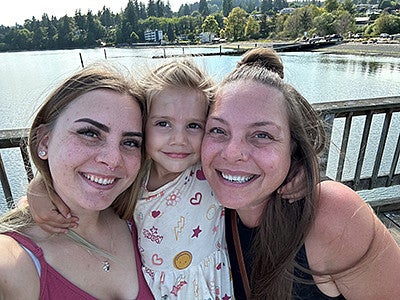
Adkins’ journey toward this career began long before she entered the field. As an undergraduate in the University of Oregon’s Family and Human Services (FHS) program, she chose a field placement she knew almost nothing about. “I hadn’t even heard of prevention as a field,” she said, reflecting on the assignment that would shape the next decade of her professional life. That single requirement to step outside her comfort zone, introduced her to a worldview where individual experiences, community systems, and public health infrastructures are interconnected. She often describes her undergraduate degree as “a degree in me,” a transformative period when she was also a single parent of four. The FHS program strengthened her confidence, parenting skills, and ecological understanding of human development, helping her see how “families, schools, systems, and policy intersect.”
Moments of belonging during her time in the College of Education shaped not only her personal growth but also her professional identity. During her first semester, Dr. Karrie Walters, PhD, shared part of her own story, openly discussing identity and belonging in the classroom. For Adkins, that moment modeled authenticity in a professional space. “It influenced how I show up in my work,” she explained, “striving to create spaces where people feel seen, respected, and supported.” That relational foundation of seeing the whole person became the lens through which she now leads large-scale mental health initiatives.
When she returned to the University of Oregon for her MEd in Prevention Science, Adkins found renewed clarity. Courses in implementation science, research methods, and prevention policy deepened her understanding of how to translate research into action. Dr. Atika Khurana’s research methods courses gave her a framework she uses daily. “She demystified quantitative and qualitative approaches and often reminded us that correlation is not causation,” Adkins said. That guidance trained her to evaluate her programs with precision and communicate findings responsibly, skills especially critical in behavioral health systems.
Her capstone project on maternal connectedness became both a professional and personal milestone. As her children entered adulthood, she found the research influencing the way she parented. Prevention, she realized, was not simply programmatic. “Prevention is relational and lifelong,” she said, a belief that now shapes how she approaches both family and community leadership.
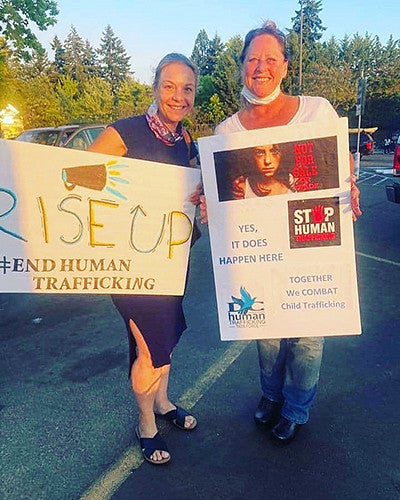
One of the clearest affirmations of her career path comes through suicide prevention training. Adkins has trained more than 1,500 educators and community members across rural Southern Oregon, plus several hundred more in other prevention-related programs. “Watching participants move from uncertainty to confidence in supporting someone experiencing suicidal thoughts is incredibly meaningful,” she shared. In rural communities where access to services is limited, building local capacity becomes transformative. The impact, she explained, “creates a ripple effect that extends far beyond the training room.”
Even amid professional demands, Adkins’ time in graduate school was shaped by the friendships and support systems that helped her navigate complexity. As a nontraditional student balancing leadership responsibility, parenting a large, blended family, and the uncertainty of early COVID‑19, the academic journey felt especially intense. Statistics classes that were moved online mid-semester due to the pandemic, proved especially challenging. But a small study group that formed organically became “both academic support and steady encouragement during a difficult time.” Those peers remain close friends, a testament to the cohort model she valued deeply throughout the College of Education.
Higher education, Adkins believes, carries both privilege and responsibility. As a Ford ReStart Scholar, she felt a strong sense of stewardship. “The value of higher education isn’t about credentials; it’s about the ripple effects,” she said. The students supported, the educators trained, the systems strengthened, all represent the broader impact of her work, even if many of those outcomes are ones she will never witness directly.
Her experiences at the University of Oregon also shaped her thinking about leadership. The Graduate Certificate in Nonprofit Management added a practical dimension, helping her translate research into sustainable systems. “Together,” she reflected, her programs “shaped my trajectory from direct service into broader systems-building focused on rural workforce capacity and long-term community wellbeing.”
Like many nontraditional students, Adkins once wrestled with imposter syndrome. She remembers vividly the first time a professor named it openly in class. “I had never heard the term before but suddenly felt seen,” she said. If she could advise her younger self, she would say: “Trust yourself and trust the process. Your nontraditional path is not lesser.”
Looking ahead, Adkins hopes to continue working at the intersection of rural education, public health, and behavioral health by designing systems that support generational wellbeing beyond the life of any one grant. She is especially focused on building prevention-centered models that prioritize wellness rather than reacting only to crisis. Sustainability, too, is a personal goal. “Preventing personal burnout is part of prevention practice,” she noted. She continues deepening her expertise in program evaluation and intentional leadership.
Even now, when she returns to campus, the College of Education building still brings “a sense of peace, grounding, growth, challenge, and belonging all at once.” It represents the beginning of a journey that shaped not only her career, but her understanding of how one person can help create systems that sustain entire communities. For Adkins, prevention is not just a profession. It is the foundation of a life dedicated to connection, courage, and long-term community wellness.