
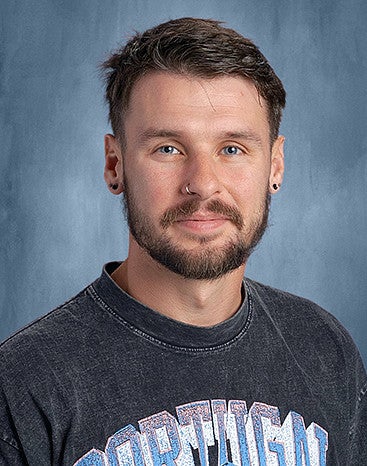
Power of Showing Up for Students: Alumni Alex Walker, UOTeach Curriculum and Teaching Program
Meet alumni Alex Walker, a 2020 graduate of the University of Oregon’s UOTeach master's program and current fifth grade teacher at Malabon Elementary. Alex also serves as Head Coach for Track and Field and Assistant Coach for Boys’ Soccer at Willamette High School.
“Find opportunity to learn from everyone and everything, and embrace that opportunity.” —Alex Walker
For Alex, teaching was never just a career path, it was a way of becoming the kind of adult he once looked up to. His work spans classrooms, playing fields, and the small, daily moments where young people discover their strengths. “I want to know that students leave my classroom feeling like their teacher knew them as an individual,” he said, “and had their hopes, dreams, and progress in mind.”
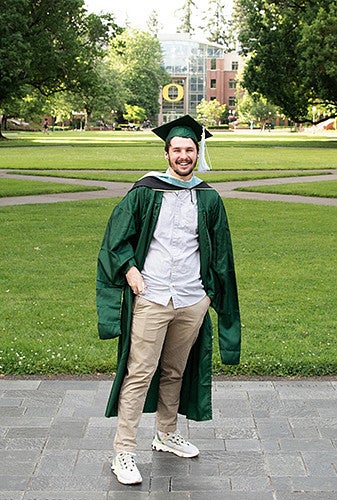
Walker’s journey toward teaching was shaped profoundly by his time in the College of Education. Recipient of the Amy Lou Ware Spencer Scholarship1 and the Rose Gross Scholarship2 in 2019-20, the UOTeach program gave Alex “a foundation for being able to teach about complex, challenging, and sensitive topics with skill and willingness to embrace the reality of teaching in polarizing times.” The rigor of the coursework paired with the vulnerability it required helped transform his sense of self. Professors like Jennifer Ruef, PhD, pushed him to reconsider what he had believed about himself as a learner. “She helped me reframe my own thinking about myself as a mathematician,” Walker said, “and helped me embrace the idea that someone who struggled with math as a student would be able to connect with students in a way that would be meaningful.” It was one of many moments when he realized that the things he once saw as limitations might actually be gifts.
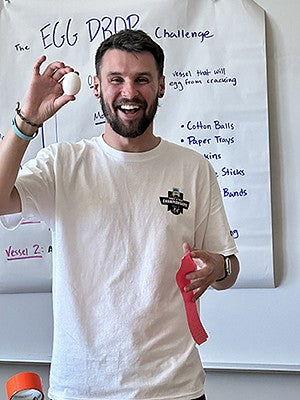
A winter-term science methods course further shifted his thinking, revealing what science education could look like at a time when curiosity felt more important than ever. That course helped him “build a concept for how I could make science meaningful and relevant to my students’ lives,” a goal that continues to guide his classroom practice.
The value of higher education also took on deeper meaning during his years in the College of Education. Being surrounded by peers who arrived at teaching through different life paths broadened his sense of the profession. “Being able to be around other future educators who had different perspectives pushed me to be a better teacher,” he said. Education had always been a priority in his family, but the program helped him understand its impact on a community level; how educators shape not only academics but identity, belonging, and resilience.
Walker’s personal support system during graduate school came from his commitment to spending time outdoors. Weekly adventures, like trips to the coast, hikes up Spencer’s Butte, and exploration of trails in the Cascades, gave him the grounding he needed to manage coursework, student teaching, and life. “Taking time away from campus helped me focus on classes and student teaching when I was on campus,” he said. These habits continue to center him and now form part of the advice he offers to new college students: “Put time into learning healthy habits. Take the time to establish a routine and stick to it and make sure that routine includes taking time to move.”
The UO campus itself became a symbol of arrival. He recalls the summer he started the master’s program, walking to class and realizing that years of preparation had led him exactly where he hoped to be. “It no longer was a future plan,” he said. “The time in classrooms, writing applications, and lots of self-reflection had led me to exactly where I wanted to be.” If he were to return to campus today, he would head straight for HEDCO and the Knight Library both spaces that grounded him during the intense, transformative year in the UOTeach master's program.
Walker’s most enduring takeaway from the College of Education came from faculty who were active K–12 teachers themselves. Learning from people who were teaching in real classrooms provided him with authentic, practical preparation. It also connected him to the Bethel School District, where several of his professors worked. Those relationships helped place the district on his radar as somewhere he could belong and where he could make a difference. “It put me in contact with people in the Bethel School District who were some of my professors,” he said, “that I ended up working alongside once I got my career.”
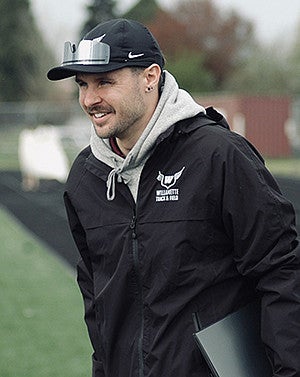
Today, those lessons echo through every practice and every lesson he teaches. As both teacher and coach, Walker sees education as a vehicle for confidence, connection, and growth. “Being able to be a part of a community as both a teacher and a coach,” he said, “I hope to be able to continue to be someone that people look to as a positive force in their lives.” He wants students to leave his classroom and his teams with the courage to take on challenges and “to celebrate the progress they make along the way.”
The full-circle moments affirm that he is exactly where he needs to be. Students from his very first class are now ninth graders, and he coaches several of them at Willamette High School. “Getting to coach a handful of them after teaching them four years earlier is a really special full-circle moment,” he reflected. The continuity of seeing students grow academically, personally, and athletically remind him daily of the power of showing up. “Every time I get a message of thanks or appreciation it reminds me that I’m exactly where I need to be.”
Looking ahead, Walker hopes to continue coaching and teaching, with plans to earn secondary endorsements so he can teach high school social studies or science. He intends to remain coaching the Willamette Track and Field and Boys’ Soccer program and to stay rooted in the community that helped shape him. His guiding philosophy which is one he now shares with future educators is simple: “Find opportunity to learn from everyone and everything and embrace that opportunity.”
For Walker, teaching is not just a profession. It is an ongoing relationship with a community, a commitment to growth, and a belief that every student deserves someone who sees their potential and who celebrates the progress along the way.
1The Amy Lou Ware Spencer Scholarship was established in 2008 by Douglas R. Spencer and family members in memory of Amy Lou Ware Spencer (1926-2003). Amy Lou was a lifetime resident of Eugene and graduated from Eugene High School. She received a bachelor’s degree in education and a master’s degree in librarian science, both from the University of Oregon.
2The Rose Gross Scholarship came to the UO in 1966 through a bequest from the estate of Rose Gross of California. Mrs. Gross supported higher education, with gifts to health education at UC Medical School and teacher education at the University of Oregon.