
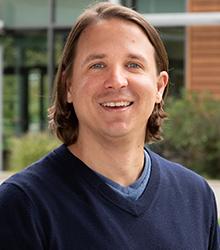
Sean Grant
Biography
Dr. Grant is a Research Professor with expertise in the synthesis of empirical evidence and expert opinion to inform policy, practice, and research. His work seeks to strengthen methods for identifying and using "what works" across the social, behavioral, and health sciences, with a particular focus on mental health and substance use disorders. He has led several projects to develop methodological standards and tools, including the CONSORT-SPI guideline for reporting social and psychological intervention trials, the Delphi Critical Appraisal Tool, RAND's methodological guidance for the Delphi method, the ROMPER Method for Policy Expert Ratings, and the RAND Patient-Centeredness Method.
At the University of Oregon, he directs research for the HEDCO Institute for Evidence-Based Educational Practice, is an investigator with the Pacific Northwest Evidence-based Practice Center and is a scientist with the Prevention Science Institute. He is also an associate member with the Department of Social Policy and Intervention at the University of Oxford and adjunct scientist with the RAND-USC Schaeffer Opioid Policy Tools and Information Center. Prior to UO, he was a Social and Behavioral Scientist at the RAND Corporation affiliated with its Southern California Evidence-based Practice Center, ExpertLens team, Drug Policy Research Center, and core faculty at the RAND School of Public Policy. Following RAND, he was an Associate Professor at the Indiana University Richard M. Fairbanks School of Public Health. Dr. Grant completed his doctorate in Social Intervention as a Clarendon Scholar at the Centre for Evidence-Based Intervention, University of Oxford.
Dr. Grant is regularly invited to advise on evidence standards and synthesis methods. He was invited by the Center for Open Science to serve as the inaugural Chair of the Transparency and Openness Promotion (TOP) Guidelines Advisory Board for its first major update (TOP 2025). In the United States, he chaired the Administration for Children and Families' technical working group on updating federal criteria for evidence-based early childhood home visiting models and served on the technical expert panel on program review and rating methodology for the Evidence-Based Practices Resource Center of the Substance Abuse and Mental Health Services Administration. Internationally, he has served as a methods advisor to the World Health Organization (Guidelines Review Committee), United Nations (Intergovernmental Panel on Climate Change, International Organization for Migration), and the Wellcome Trust (Evidence Synthesis Infrastructure Hubs Advisory Committee).
Dr. Grant serves the field as the inaugural Methodological Transparency Editor of the Journal of Research on Educational Effectiveness, Associate Methods Editor of Campbell Systematic Reviews, and an editorial board member of Prevention Science. At the Society for Prevention Research, he co-chairs the Standards of Evidence Task Force and special interest groups on open prevention science and research synthesis methods, which has involved guest-editing two special issues of Prevention Science. He is a member of MDRC's The Higher Education Randomized Controlled Trial (THE-RCT) Network and the advisory board for the GALENOS global living evidence platform for mental health research. For the Office of Planning, Research, and Evaluation, he has advised on the Maternal, Infant, and Early Childhood Home Visiting learning agenda; the Healthy Marriage and Relationship Education research portfolio; the Annual Methods Meeting; and the Home Visiting Evidence of Effectiveness and Prevention Services Clearinghouses. His previous service includes chairing the Society for Research Synthesis Methodology's Strategic Plan Task Force, co-chairing the planning committee for the Addiction Health Services Research conference, and serving on the Indiana Division of Mental Health and Addiction's workgroup on evidence-based substance use prevention. He has mentored more than 50 students and early-career researchers throughout his career, including as Director of the HEDCO Undergraduate Scholars Program.
Education
DPhil, 2014, University of Oxford, Oxford, UK
Major: Social Intervention (no corrections)
MSc, 2011, University of Oxford, Oxford, UK
Major: Evidence-Based Social Intervention (with distinction)
Honors BA, 2010, Loyola Marymount University, Los Angeles, CA
Major: Psychology (summa cum laude)
Minor: Economics
Honors BA, 2010, Loyola Marymount University, Los Angeles, CA
Major: Philosophy (summa cum laude)
Honors and Awards
2025 Society for the Improvement of Psychological Science Mission Award (co-recipient)
2024 Nan Tobler Award for Review of the Prevention Science Literature, Society for Prevention Research
2022 Favorite Professor, IUPUI Athletics
2019 Travel Award, MetaScience Symposium
2017 Early Career Investigator Award, Addiction Health Services Research Conference
2016 Bob Brook Award, RAND Health
2015 Leamer-Rosenthal Prize for Emerging Researchers in Open Social Science, Berkeley Initiative for Transparency in the Social Sciences
2014 Finalist, NIH Director’s Early Independence Award, National Institutes of Health
2012 Barnett Prize, Department of Social Policy & Intervention, University of Oxford
2011 Teresa Smith Award, Department of Social Policy & Intervention, University of Oxford
2011 Clarendon Scholarship, University of Oxford
2010 Valedictorian, Loyola Marymount University
2006 Trustee Scholarship, Loyola Marymount University
Publications
Grant, S., Corker, K.S., Mellor, D. M., Stewart, S. L. K., Cashin, A. G., Lagisz, M., …. on behalf of the TOP Guidelines Advisory Board. (accepted). TOP 2025: An Update to the Transparency and Openness Promotion Guidelines. Research Integrity & Peer Review.
Grant, S., Trevino, S. D., Steinka-Fry, K., Day, E., Cabrera, B., Hamilton, S., Martinez, S., Chinn, L. K., & Tanner-Smith, E. E. (2026). The four-day school week at K-12 schools in the United States: A scoping review of empirical research evidence. Educational Evaluation and Policy Analysis, 48(2), 793-802. doi: 10.3102/01623737251362865
Grant, S., & Khodyakov, D. (2025). DCAT: a critical appraisal tool for studies using the Delphi method. BMJ, 391, e084509. doi: 10.1136/ bmj-2025-084509
Grant, S., Schweer-Collins, M., Day, E., Trevino, S. D., Steinka-Fry, K., & Tanner-Smith E. E. (2025). Effectiveness of school-based depression prevention interventions: An overview of systematic reviews with meta-analyses. Journal of Consulting and Clinical Psychology, 93(4), 194–212. doi: 10.1037/ccp0000930
Grant, S., Smart, R., & Stein, B. D. (2025). Creating a classification system of opioid use disorder treatment policies: A research protocol. Substance Use & Addiction Journal, 46(4), 1053-1057. doi: 10.1177/29767342251355086
Grant, S., Dussan, H., Sebree, M., Trevino, S. D., Steinka-Fry, K., Chinn, L. K., Day, E., & Tanner-Smith, E. E. (2025). Reporting of student demographics in school-based depression prevention trials: The need for a core baseline set in school psychology. School Psychology Review. doi: 10.1080/2372966X.2025.2530919
Grant, S., Smart, R., Gordon, A. J., Pacula, R. L., & Stein, B. D. (2024). Expert views on state policies to improve engagement and retention in treatment for opioid use disorder: A qualitative analysis of an online modified-Delphi process. Journal of Addiction Medicine, 18(2), 129-137. doi: 10.1097/ADM.0000000000001253
Grant, S., & Khatua, S. (2024). Research transparency and reproducibility at the International Initiative for Impact Evaluation, Journal of Development Effectiveness, 16(3), 363-373. doi: 10.1080/19439342.2024.2388102
Grant, S., & Smart, R. (2024). ROMPER: The RAND/USC OPTIC Method for Policy Expert Ratings. MethodsX, 12, 102751. doi: 10.1016/j.mex.2024.102751
Grant, S., Mayo-Wilson, E., Kianersi, S., Naaman, K., & Henschel, B. (2023). Open science standards at journals that inform evidence-based policy. Prevention Science, 24, 1275–1291. doi: 10.1007/s11121-023-01543-z
Research
Dr. Grant's research program centers on making evidence credible and usable for decision-making. At the University of Oregon, he applies these methods through the HEDCO Institute's Living Evidence Model: AI-enabled living evidence syntheses on pressing questions facing K-12 schools that are continuously updated as new research emerges. Current topics include four-day school week policies and school-based interventions to prevent mental health issues. His team translates findings from these syntheses for decision-makers through evidence summaries, policy briefs, and interactive dashboards. All research protocols, materials, data, and code freely available on the Open Science Framework. Over the course of his career, Dr. Grant has published more than 110 peer-reviewed articles that collectively have been cited more than 6,400 times. He has been invited by numerous organizations to deliver presentations on his research, including the National Academy of Sciences, the National Institutes of Health, Federation of American Scientists, and U.S. Offices of Evaluation Sciences, Assistant Secretary for Planning and Evaluation, and Planning, Research, and Evaluation. His research has been featured by media outlets including Education Week, The 74, The Guardian, NPR, and CBS. He has received external support for his research program from the Administration for Children and Families, Arnold Ventures, Education Endowment Foundation, Fetzer Franklin Fund, National Institute on Drug Abuse, Patient-Centered Outcomes Research Institute, Robert Wood Johnson Foundation, United Kingdom Economic and Social Research Council, United States Departments of Defense and Veterans Affairs, Wallace Foundation, and William T. Grant Foundation.