
Growing Care, Training, and Community Impact
by Andrea Olson
May 28, 2026
The University of Oregon College of Education’s HEDCO Clinic serves children, adults, and families who are often navigating complex and unfamiliar challenges. During pivotal moments in their lives, clients seek guidance, understanding, and practical support. At the HEDCO Clinic, care is designed to meet individuals where they are, addressing learning, communication, neurodevelopmental, and mental and behavioral health needs with compassion and expertise.
“When my family moved to Eugene, we were new to the community and navigating many unknowns,” shared Wesley Stewart, senior associate vice president for advancement at the University of Oregon. “Our child has learning and behavioral needs, so after learning about the HEDCO Clinic we started using their services, not just for our child, but for us as parents. It was a holistic, compassionate approach that made a profound difference in our lives.”
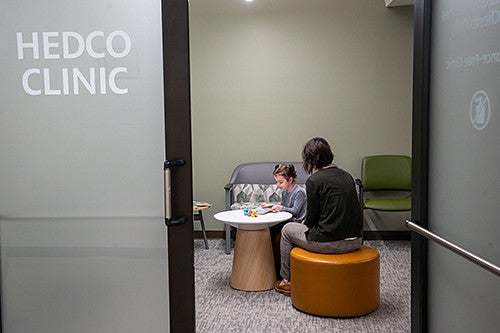
The HEDCO Clinic is the College of Education’s interdisciplinary training and clinical service hub, connecting families with essential services while preparing the next generation of education and health professionals. Clients of all ages receive support for speech and language challenges, neurodevelopmental needs and screenings, and counseling services, many offered at reduced cost to expand access for families with limited financial resources.
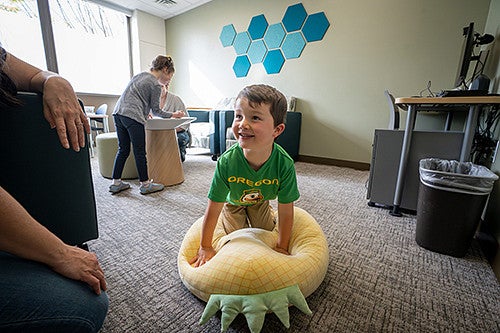
In January, the HEDCO Clinic expanded into a newly remodeled suite in the adjacent Clinical Services Building (CSB). The new space allows the Clinic to serve more individuals and families each year while enhancing training opportunities for students pursuing professional degrees. “Since expanding into the new CSB space, we’ve significantly improved access to care for our community,” said Lindsay Feltis, Clinical Assistant Professor and Supervisor at the HEDCO Clinic. “The increased capacity allows us to serve more clients, including those with diverse and complex needs. With dedicated spaces like the sensory room, we’re now able to better support individuals who require a quiet, regulated environment, making services more accessible and effective for those who may not have been able to engage before.”
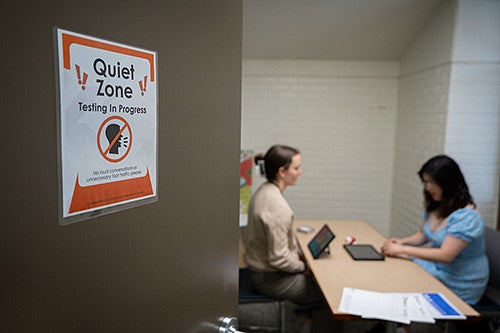
Expanded clinical rooms, observation areas, and shared spaces also strengthen how students learn in real-world settings. “The expanded CSB space has meaningfully strengthened the quality of supervision,” Feltis added. “With features like observation rooms equipped with one‑way mirrors, supervisors can provide real‑time, in‑the‑moment feedback while still allowing students the autonomy to make decisions and engage in clinical problem‑solving. This thoughtful design supports a balance of guidance and independence, ultimately enhancing skill development and ensuring high‑quality supervision.”
Last year, the HEDCO Clinic’s seven centers served 1,775 individual clients and trained 140 College of Education students across counseling, speech‑language pathology, and related fields. Philanthropic partnerships demonstrate what is possible when community organizations and individuals invest in access and equity. Support from partners such as the Oregon Scottish Rite helps remove financial barriers for families, allowing low-income clients to receive services through the Speech Language and Hearing Center while students gain the supervised clinical experiences that shape their professional development.
Reflecting on the experience that first brought their family to the Clinic, Stewart shared why supporting this work continues to matter. “Our time at the HEDCO Clinic changed how I understand the power of accessible, interdisciplinary care,” Stewart said. “Choosing to support the Clinic as a donor allows me to help ensure that same level of care and training is available to others.”
As the HEDCO Clinic enters this new chapter, its expanded footprint reflects a shared commitment to accessible care, experiential learning, and community wellbeing, advancing the College of Education’s mission today and for generations to come.